The 2020 National Building Code of Canada (NBCC) mandates specific bearing capacity and settlement limits that dictate foundation design. In Saint-Jerome, where the Rivière du Nord carved a valley through glaciofluvial deposits, achieving these limits often requires deep ground improvement. Our vibrocompaction design focuses on the granular terraces common to the 45.778°N corridor, using depth-specific vibratory energy to densify loose sands and gravels. The local geology, shaped by post-glacial rebound, leaves pockets of low-density material below the water table—a condition where surface compaction proves inadequate. We integrate CSA A23.3 requirements with site-specific response data, often combining our approach with CPT testing to verify pre- and post-treatment cone resistance. For sites near the riverbank where fines content increases, we evaluate the transition zone to determine where vibro-replacement via stone columns becomes the more effective alternative.
A 1.5-meter probe spacing error in vibrocompaction design can leave a soft column untreated—compromising foundation uniformity across the entire grid.
Process and scope
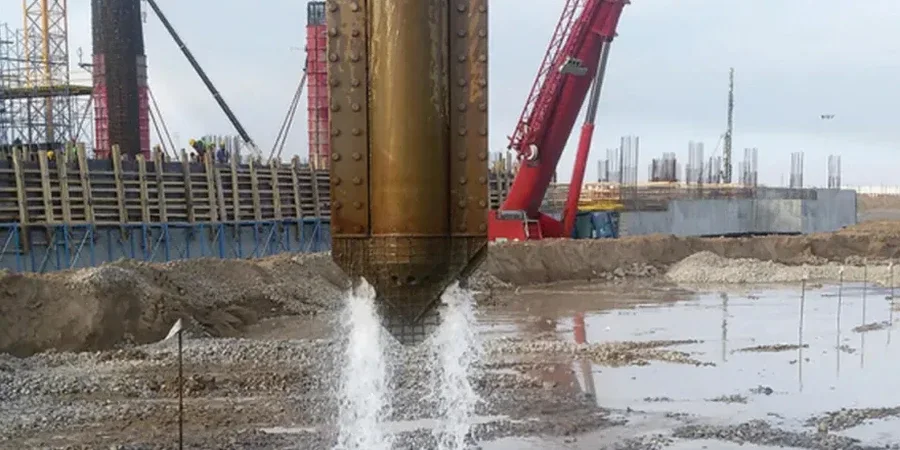
Site-specific factors
A common mistake among contractors new to the Laurentides region is assuming that a single pre-construction borehole represents the entire Saint-Jerome site. Glaciofluvial deposits are notoriously heterogeneous; a lens of silty sand bypassed during vibrocompaction design can settle differentially under load, cracking the slab within two freeze-thaw cycles. The risk compounds when groundwater is high and the vibrator's lateral influence shrinks. We've observed cases where poorly designed grids left untreated columns between probe points, leading to post-construction litigation. Another critical failure mode involves over-compacting dense gravel, which wastes energy and can fracture the aggregate structure. The fix is a phased approach: initial test sections monitored with cross-hole seismic to calibrate spacing before full production. Ignoring the interaction between vibration frequency and the soil's natural frequency is where theory separates from practical, site-proven design.
Reference standards
NBCC 2020 (National Building Code of Canada), CSA A23.3: Design of Concrete Structures (foundation references), ASTM D2487 - Unified Soil Classification System, ASTM D6066 - Practice for Determining Normalized Penetration Resistance, BNQ 2501-250 / CAN/CSA-A23.1 (aggregate reference)
Other technical services
Preliminary Vibro Feasibility & Desk Study
Review of existing geotechnical reports and grain-size curves to determine if soil fines content falls below the 12% vibrocompaction threshold. We correlate historical data from Saint-Jerome's industrial park and residential zones.
Production Design & Grid Optimization
Detailed probe layout with depth intervals and hold times. We specify vibrator power, frequency, and water/air flush parameters. Includes calculation of settlement reduction factor and predicted post-treatment bearing capacity.
QA/QC Verification & Final Report
Supervision of CPT and SPT verification testing at 5% to 10% of probe locations. The final report includes as-built grid coordinates, amperage logs, and a stamped statement of NBCC compliance for the Saint-Jerome building permit.
Typical parameters
FAQ
What is the typical cost range for vibrocompaction design in Saint-Jerome?
Professional vibrocompaction design fees in Saint-Jerome typically range from CA$1,770 to CA$7,860. The scope depends on treatment area size, required depth (often 10-25 meters in the Rivière du Nord deposits), and the complexity of the verification program. A small commercial lot with straightforward granular soils will fall at the lower end, while an industrial facility requiring a phased test section and extensive CPT verification approaches the upper limit.
How do you determine if the soil in Saint-Jerome is suitable for vibrocompaction?
Suitability hinges on grain-size distribution. We require the fines content (passing #200 sieve) to be below 12% for pure vibrocompaction. In Saint-Jerome's glaciofluvial terraces, the D50 typically ranges from 0.5 mm to 5 mm, which responds well to vibratory energy. We run sieve analyses from our laboratory and cross-reference them with CPT pore pressure data (Ic soil behavior type) to confirm that a vibrator can achieve the specified relative density without excessive cycling.
What NBCC 2020 provisions directly affect vibrocompaction design?
NBCC 2020 Part 4 governs structural design, referencing CSA A23.3 for foundations. The key implication is the requirement for an ultimate limit state (ULS) bearing capacity and a serviceability limit state (SLS) total settlement typically not exceeding 25 mm. Our vibrocompaction design must demonstrate—through post-treatment CPT data and empirical settlement calculations—that the improved ground meets these limits under the Saint-Jerome seismic hazard, which ranges from 0.25g to 0.35g peak ground acceleration.
How long does the vibrocompaction design and verification process take?
The design phase, including desk study and grid layout, generally takes 5 to 8 business days after receiving the initial geotechnical data. A field trial section, if required for Saint-Jerome site calibration, adds 2 to 3 days of mobilization and testing. The final QA/QC report with all verification CPT logs and NBCC compliance statements is delivered within 10 business days of completing field work.