The freeze-thaw cycles in the Laurentians are relentless. In Saint-Jerome, we see it every spring: slopes that moved just enough during winter to become a problem by April. The Rivière du Nord carved a valley through marine clay and glacial till, leaving behind terraces that look stable until you dig into them. For any project near the riverbank or along the escarpments of the Piemont, a slope stability analysis is not optional. It is the difference between a foundation that lasts and one that slides after the first heavy rain. We combine local drilling data with limit equilibrium methods to assess factor of safety under both static and seismic conditions, per NBCC 2020. The geology here does not forgive shortcuts, and we learned that working on sites from the old industrial district to the newer developments up on the moraine. Often we integrate findings from a test pit to verify shallow stratigraphy before running the full stability model.
A slope that looks stable during a dry August can reach critical failure conditions after a single week of spring melt combined with heavy rain.
Process and scope
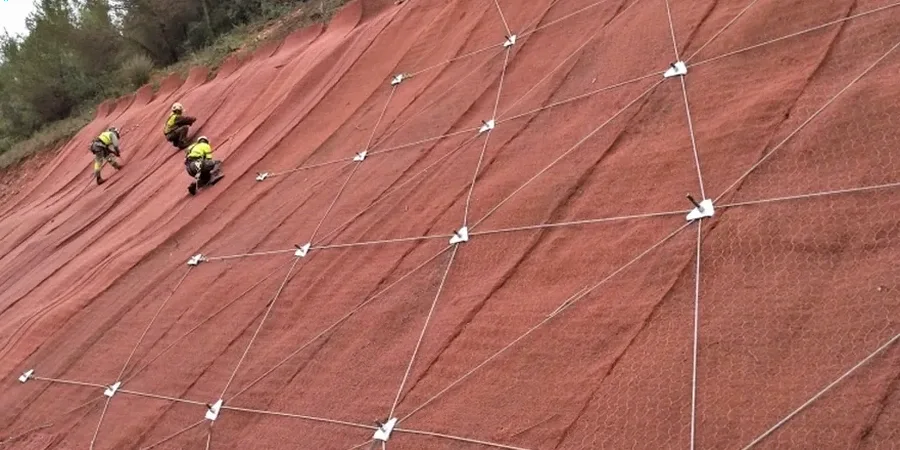
Site-specific factors
We often see retaining walls in Saint-Jerome that were built without a global stability check. The wall itself stands, but the entire slope behind it creeps downhill. In one case near the old paper mill, a gabion wall rotated forward because the failure surface passed underneath it through a soft clay layer at 6 meters depth. The wall was fine. The slope was not. Another common issue is uncontrolled surface water. A roof downspout discharging onto the crest of a slope can trigger a shallow slide in the colluvium within a single season of snowmelt. We learned to walk the site after a heavy rain before finalizing our model. The catchment area above the slope matters as much as the soil properties. We always recommend drainage as the first line of defense before considering more expensive structural solutions like anchors or retaining walls.
Watch the video
Reference standards
NBCC 2020 (National Building Code of Canada), CSA A23.3 (Design of Concrete Structures), ASTM D4318 (Atterberg Limits), ASTM D2850/D4767 (Triaxial Compression), CFEM (Canadian Foundation Engineering Manual, 4th Edition)
Other technical services
Natural slope assessment for new construction
For vacant lots on hillside terrain in Saint-Jerome. We evaluate global stability under NBCC 2020 seismic and static conditions to define safe building setbacks.
Engineered cut and fill slope design
For residential subdivisions and commercial pads where grading changes the natural profile. We specify benching, reinforcement, and compaction to achieve FoS ≥ 1.5.
Forensic analysis of existing slope failures
When a slope moves, we back-analyze the failure to determine the operative shear strength and design a remediation that addresses the root cause, not just the symptom.
Typical parameters
FAQ
What does a slope stability analysis cost for a typical residential lot in Saint-Jerome?
For a standard residential lot requiring a natural slope evaluation and a single cross-section analysis, costs range from CA$1,490 to CA$3,200 depending on access and the extent of drilling needed. More complex sites with multiple cross-sections, seismic analysis, or deep soft clay can reach CA$4,800 to CA$6,320.
What is the biggest geotechnical risk for slopes in the Saint-Jerome area?
The biggest risk is the presence of sensitive marine clay in the low-lying terraces. This clay can lose significant strength when disturbed or saturated, leading to progressive failure. Up on the moraines, the risk shifts to perched groundwater and boulder obstructions that complicate drainage design.
Do you use 2D or 3D analysis for slope stability?
We primarily use 2D limit equilibrium analysis with software that allows complex stratigraphy and variable pore pressure conditions. For most sites in Saint-Jerome, 2D analysis along the critical cross-section is appropriate and is the standard of practice under the Canadian Foundation Engineering Manual. 3D analysis is reserved for sites with complex topography where the failure surface is constrained laterally.
What triggers a mandatory slope stability study under the Saint-Jerome building code?
Any construction on a slope steeper than 15% or within a distance equal to the slope height from the crest typically triggers a geotechnical review. The specific setback requirements are defined by the city's zoning and are cross-referenced with NBCC 2020 and the CFEM. We can help determine the exact study scope during a preliminary site visit.