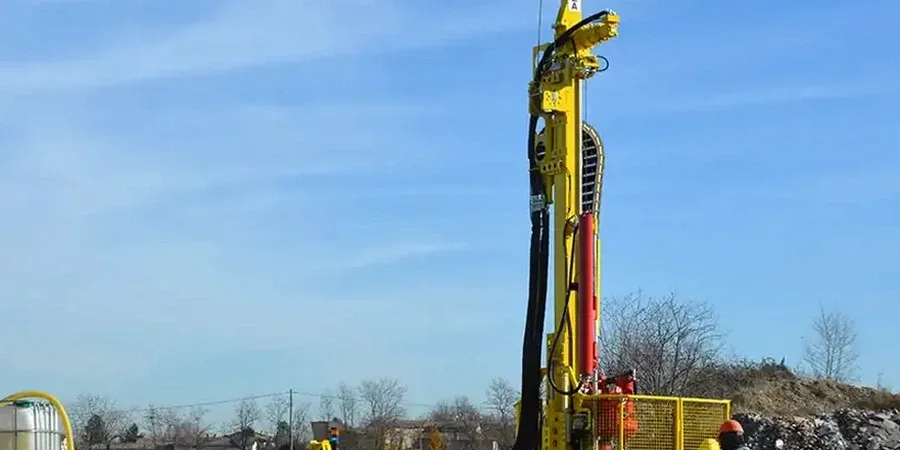
When we mobilize a CME-55 track-mounted drill to Saint-Jérôme, the first thing we look for is the transition zone between the sandy terraces of the Rivière du Nord and the dense till uplands. The rig’s 140-pound safety hammer drops 30 inches onto the A-rod, and the blow count over the final 12 inches is what we log as the N-value. In this part of the Lower Laurentians, the overburden can shift from loose alluvial silts to a hard-packed lodgement till within a few meters, which makes a high-quality SPT drilling program non-negotiable. We use split-spoon samplers with a 2-inch OD and line them up with hollow-stem augers to keep the borehole stable, especially when we’re working near the old pulp-and-paper terraces where historical fill is common. The team runs at least three boreholes per site to capture lateral variability, and we log recovery, moisture, and pocket penetrometer readings right at the rig.
In the Laurentian till, an uncorrected N-value above 50 often masks a true N60 closer to 35—energy calibration matters more than the raw count.
Process and scope
Site-specific factors
The Champlain Sea clays that reach their northern limit around Saint-Jérôme introduce a classic Laurentian risk: sensitive silty clays that lose strength when remolded. We’ve pulled split spoons where the sample looked firm in the shoe but collapsed into a slurry when extruded—that’s the signature of a quick clay, and it demands conservative N-value interpretation. A blow count of 8 in that material does not mean the same thing as an N of 8 in a dense sand. The seismic hazard here, governed by the Western Quebec Seismic Zone, adds a second layer of scrutiny. Under NBCC 2020, Site Class E soils require a site-specific response analysis, and our SPT data feeds directly into the shear-wave velocity correlations we need for that. The third risk is groundwater: in the spring melt, perched water tables rise rapidly in the sandy upper till and can turn an excavation into a mess if the contractor isn’t warned ahead of time.
Reference standards
NBCC 2020 (National Building Code of Canada), CSA A23.3:19 (Design of Concrete Structures), ASTM D1586 / D4633 (SPT and Energy Calibration)
Other technical services
Geotechnical Drilling and Sampling
Track-mounted auger drilling with continuous SPT sampling at 1.5 m intervals. We log soil stratigraphy, install monitoring wells, and collect undisturbed Shelby tube samples in soft clay layers for lab shear testing.
Foundation Design Parameters Package
We translate N60 profiles into allowable bearing pressures, settlement estimates, and seismic site class per NBCC Table 4.1.8.4.A. The package includes liquefaction screening for sandy layers below the water table.
Typical parameters
FAQ
How much does SPT testing cost for a typical Saint-Jérôme residential lot?
For a standard residential project requiring two to three boreholes to 8–10 m depth, the cost typically falls between CA$740 and CA$920 per borehole, including mobilization within the Saint-Jérôme area, hollow-stem auger drilling, SPT sampling at regular intervals, and a factual report with N60 profiles. Sites with difficult access or extensive historical fill may require additional setup time.
What depth do you usually drill for an SPT in the Saint-Jérôme area?
Most residential and light commercial boreholes go to 10–12 m, which typically gets us through the upper weathered till and into the competent gray till. For heavier structures or when we suspect Champlain Sea clay, we extend to 15–18 m to evaluate consolidation settlement potential.
How do you handle the dense glacial till that stops the sampler early?
We log refusal at 50 blows per 6 inches of penetration, per ASTM D1586. In Saint-Jérôme’s basal till, we often hit refusal between 6 and 9 m depth. We note the N-value at refusal, switch to rock coring if the client needs deeper data, and apply energy corrections to avoid overestimating the bearing capacity of the till layer above refusal.
Do you need a drill rig that can access small backyards in Saint-Jérôme?
Yes, our CME-55 is track-mounted and can pass through a 42-inch gate, which handles most Saint-Jérôme residential lots. For extremely tight access near the older parts of town, we can use a portable tripod rig with the same safety hammer and split-spoon setup, though production is slower.
What information do you need before mobilizing for SPT drilling?
We need the civic address, a site plan showing the proposed building footprint, and any known underground utilities. For commercial projects, a DigInfo request through Info-Excavation is mandatory before we break ground. We also ask about previous fill operations—many lots near the old textile mills have buried foundations that can damage augers.