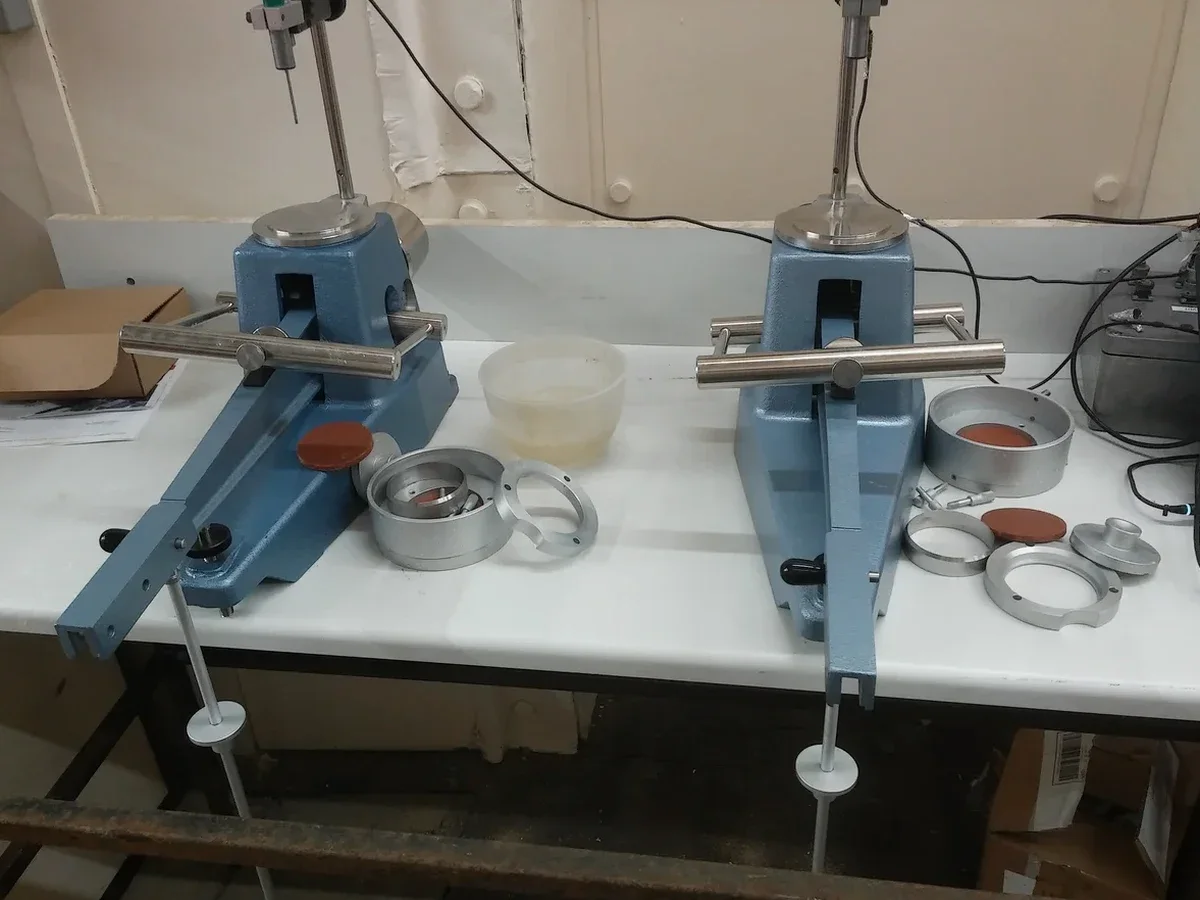
A stainless steel Casagrande cup with a calibrated cam and flat grooving tool sits on a bench next to a set of glass plates and a moisture balance. In Saint-Jerome, that setup gets used constantly on the silty-clay deposits that line the Riviere du Nord floodplain and the glacial till slopes further upland. These simple tools define the Atterberg limits: the water contents where a fine-grained soil shifts from brittle solid to plastic paste, then to viscous liquid. Without them, a foundation design or cut slope in the Laurentides is just guessing. Our testing follows ASTM D4318 procedures, complementing field data from SPT drilling and test pits that retrieve the undisturbed samples we need to run the limits.
Plasticity isn't just a number. In Saint-Jerome's silty-clay bands, it determines whether a foundation drains or heaves.
Process and scope
Site-specific factors
Saint-Jerome sits at the transition between the St. Lawrence lowlands and the Laurentian shield. That means the soil column can shift from well-drained sand to impervious silty clay within a single building lot. The real risk comes from the freeze-thaw cycles that hit five to six months a year: a soil with a high plasticity index will hold water, freeze, and lift a lightly loaded slab or a shallow retaining wall footings. If the liquid limit is misjudged, the soil is classified as silt when it is actually fat clay, and the drainage design fails. We have seen this on commercial pads along Boulevard du Cure-Labelle where spring heave cracked a slab before the steel framing even went up. The Atterberg limits test is the cheapest insurance against that failure mode: three cups, two hands, and a scale, but it gives the exact plasticity range the geotechnical engineer needs to specify frost protection depth and under-slab drainage.
Reference standards
ASTM D4318-17 Standard Test Methods for Liquid Limit, Plastic Limit, and Plasticity Index of Soils, CSA A23.3 Design of Concrete Structures (references soil classification for foundation design), NBCC 2015 Division B Part 4 (structural design; relies on site-specific geotechnical parameters)
Other technical services
Liquid Limit (Casagrande)
Multipoint determination using the standard brass cup and hard-rubber base. Run on material passing the No. 40 sieve. Suitable for all fine-grained soils encountered in Saint-Jerome.
Plastic Limit
Hand-rolling method on glass plates. We run at least three trials per sample and report the average. Defines the lower bound of the plastic state.
Plasticity Index & Classification
Calculated as LL minus PL. Used to assign USCS group symbols (CL, CH, ML, MH) and to estimate swelling potential and drained shear strength.
Shrinkage Limit (optional)
For projects where volume change is critical, we run the shrinkage limit according to ASTM D4943. Useful for liners, clay cores, and embankments on sensitive clays.
Typical parameters
FAQ
What do the Atterberg limits actually tell an engineer?
They define the water content boundaries between solid, semi-solid, plastic, and liquid states for a fine-grained soil. The liquid limit and plasticity index classify the soil under USCS, which directly feeds into bearing capacity estimates, lateral earth pressure coefficients, and drainage design. A high plasticity clay behaves very differently from a low plasticity silt, even if both look similar in a hand specimen.
What does Atterberg limits testing cost in Saint-Jerome?
For a standard pair of liquid limit and plastic limit on a single sample, the fee ranges from CA$80 to CA$120 depending on sample preparation time and whether we need to run a full multipoint LL or a single-point verification. If the sample requires extended drying or includes organic matter, the cost can shift slightly.
How long does it take to get results back?
Routine turnaround is three to five business days from sample reception. If the project is time-sensitive, we can push results in 48 hours for a surcharge, provided the sample moisture condition allows accelerated oven drying without altering the clay fraction.