Saint-Jerome’s shift from a pulp-and-paper hub to a thriving residential and logistics corridor north of Montreal has placed new demands on its subsurface. The Rivière du Nord carved a valley of silty terraces and shallow bedrock, while glacial till blankets the higher benches near Bellefeuille. Builders who treat the whole area as uniform gravel quickly learn an expensive lesson. A proper soil mechanics study ties laboratory classification to in-situ behaviour under frost and seismic load, giving structural designers parameters that the National Building Code of Canada actually requires. When a strip mall foundation cracks three winters in or a retaining wall tilts after a wet spring, the root cause is almost always the same: assumptions made without a grain-size analysis to confirm drainage capacity, or skipping slope stability checks on those gentle Laurentian inclines that hide sensitive clay lenses.
Saint-Jerome’s glacial stratigraphy can change from dense till to soft lacustrine silt within 40 metres—a soil mechanics study maps that boundary before it becomes a change order.
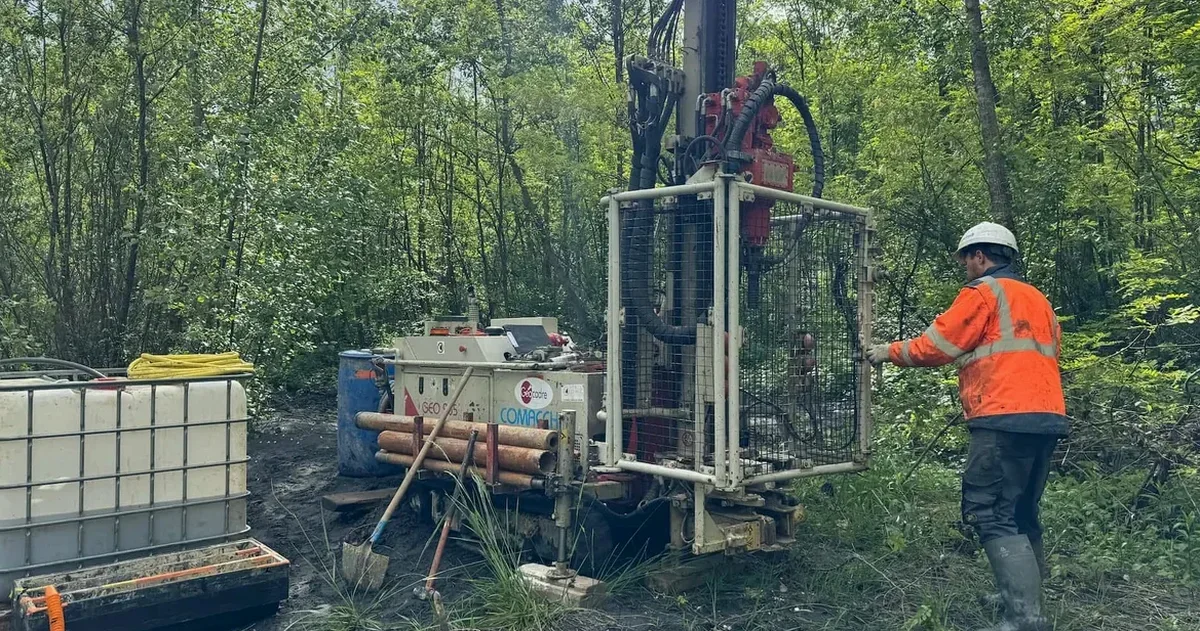
Process and scope
Site-specific factors
The Rivière du Nord floodplain deposits include pockets of compressible organic silt that geotechnical drillers have logged at depths of 4 to 9 metres near the old paper mill terraces. When a soil mechanics study skips consolidation testing on these layers, the owner inherits settlement that can drag on for years after construction. Seismic risk compounds the problem: Saint-Jerome lies within the Western Quebec Seismic Zone, where a magnitude 5.0 event has a roughly 15% probability of exceedance in 50 years. Soft soil profiles amplify ground motion, so a Site Class D designation triggered by just two metres of weak clay can increase design spectral acceleration by 30 percent or more. The cost of ignoring that number is far higher than the investigation that catches it. We also check for frost-susceptible silt using CSA A23.3 guidelines, because a heaving slab-on-grade in a Saint-Jerome warehouse is a recurring insurance claim that a single grain-size curve could have prevented.
Reference standards
NBCC 2015 (National Building Code of Canada, seismic provisions), CSA A23.3 (Design of concrete structures, frost durability), ASTM D2487 (Unified Soil Classification System), ASTM D1586 (Standard Penetration Test), Quebec Construction Code, Chapter I, Building
Other technical services
Site Investigation & Sampling
Drilling, test pits, and sampling across Saint-Jerome’s variable terrain, from the valley floor to the higher glacial benches, with logging by engineers who know the local stratigraphy.
Laboratory Testing Program
Grain-size distribution, Atterberg limits, triaxial shear, and consolidation tests run in our ISO 17025-accredited lab to produce defensible design parameters.
Geotechnical Interpretive Report
A sealed document covering bearing capacity, settlement predictions, frost protection, seismic site class, and earth pressure recommendations—formatted for municipal permit submission.
Construction-Phase Support
On-site confirmation of subgrade conditions during excavation, fill compaction testing with nuclear gauge, and rapid re-assessment if conditions differ from the investigation.
Typical parameters
FAQ
How much does a soil mechanics study cost for a residential lot in Saint-Jerome?
For a standard single-family residential lot in Saint-Jerome, a soil mechanics study typically ranges from CA$3,890 to CA$7,310. The final figure depends on access, depth of investigation required, and whether the municipality requests additional testing such as percolation or chemical analysis.
What depth of investigation is typical for a commercial building in Saint-Jerome?
Most commercial projects in Saint-Jerome require boreholes to a depth of 10 to 15 metres, or refusal on competent bedrock. If the geophysical survey suggests shallow bedrock, we still drill at least 3 metres into sound rock to rule out weathered zones that could compromise drilled shaft capacity.
Does the City of Saint-Jerome require a soil mechanics study for a building permit?
Yes, the City of Saint-Jerome’s building permit application for any structure larger than a detached accessory building typically requires a geotechnical report sealed by a Quebec-licensed engineer. The report must address bearing capacity, frost protection, and drainage implications for the specific lot.
How long does the investigation and reporting process take?
Fieldwork usually takes one to two days on site. Laboratory testing adds 10 to 15 business days depending on consolidation and triaxial schedules. The final interpretive report is delivered within three to four weeks from mobilization, though we can expedite for projects facing tight financing or permit deadlines.
Can you test for pyrite or other problematic minerals in Saint-Jerome soils?
Yes, we include petrographic examination and chemical testing for sulfide minerals when the geological context suggests potential for swelling or acid rock drainage. The shale bedrock underlying parts of the Saint-Jerome area has historically shown trace pyrite, and testing is inexpensive insurance against future heave claims.