We remember a mixed-use project on Rue Saint-Georges where the developer had already ordered formwork for isolated footings before we even pulled the first Shelby tube. The borehole log told a different story: eight meters of soft, compressible silty clay with a water table at less than two meters. Shifting to a mat foundation design was not just a recommendation, it was the only way to keep differential settlement under 25 mm without resorting to deep piling. In Saint-Jerome, where the interface between glacial till and Champlain Sea sediments creates abrupt transitions over short distances, this kind of last-minute redesign happens more often than anyone likes to admit. When we couple our laboratory consolidation curves with in-situ permeability tests run directly in the borehole, the geotechnical model tightens enough to justify a raft solution with confidence under Part 4 of the NBCC.
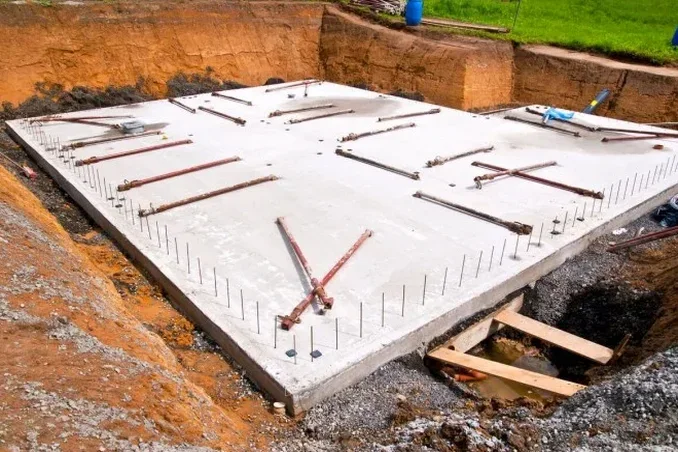
A mat foundation in Saint-Jerome clay works because it turns a settlement-sensitive soil into a problem of average pressure, not peak pressure.
Process and scope
Site-specific factors
The most common mistake we see in Saint-Jerome is treating a raft foundation as just a thicker slab on grade, with no sub-slab drainage layer and no perimeter insulation. In a Champlain Sea clay environment, that approach fails twice: first, because frost heave lifts the uninsulated edge and cracks the slab within two winters; second, because the trapped pore water under the mat never dissipates, turning the bearing layer into a lubricated film after a wet spring. We have walked onto sites where the differential movement reached 40 mm before the drywall was even taped. A proper raft design here requires a 200 mm minimum free-draining crushed stone layer with a geotextile separator, a working surface compacted to 98% standard Proctor, and a perimeter insulation detail that keeps the frost bulb outside the loaded area. If the sensitivity of the clay exceeds 8, even the construction traffic sequence needs to be planned so that remolding does not create soft spots under the future mat.
Reference standards
NBCC 2020 (National Building Code of Canada, Part 4), CSA A23.3:19 (Design of Concrete Structures), ASTM D2435 (One-Dimensional Consolidation Properties), ASTM D4767 (Consolidated-Undrained Triaxial Compression), BNQ 2501-092 (Soils — Determination of Frost Susceptibility)
Other technical services
Geotechnical Investigation for Raft Design
Boreholes with Shelby tube sampling, field vane tests in sensitive clay, and piezometer installation to map the groundwater regime before mat sizing.
Settlement and Bearing Capacity Analysis
One-dimensional consolidation and triaxial testing to generate the compression index, recompression ratio, and undrained strength envelope used in finite element or Winkler spring models.
Frost Protection and Drainage Detailing
Thermal analysis to size perimeter insulation, sub-slab drainage design with geotextile and clear stone, and construction-phase dewatering recommendations for excavations in low-permeability clay.
Typical parameters
FAQ
How much does a raft/mat foundation design cost for a Saint-Jerome project?
The design phase — including the geotechnical investigation, lab testing, and structural coordination for a mat foundation — typically ranges from CA$1,600 to CA$6,500, depending on building footprint, number of boreholes, and whether specialized consolidation or triaxial testing is required.
When is a mat foundation better than deep piles in Saint-Jerome clay?
A mat becomes the preferred solution when the competent bearing stratum is deeper than 15 to 20 meters, making piles uneconomical, or when the structure can tolerate controlled total settlement but not the differential movement that isolated footings would produce in highly plastic Champlain Sea clay.
Does a raft foundation in Saint-Jerome require frost protection even with a heated basement?
Yes. The perimeter edge of the mat loses heat faster than the central area, and uninsulated edges in Saint-Jerome's 1.5–1.8 m frost zone will heave unless protected by rigid extruded polystyrene insulation extending horizontally or vertically below the frost line, per the thermal analysis required under NBCC.