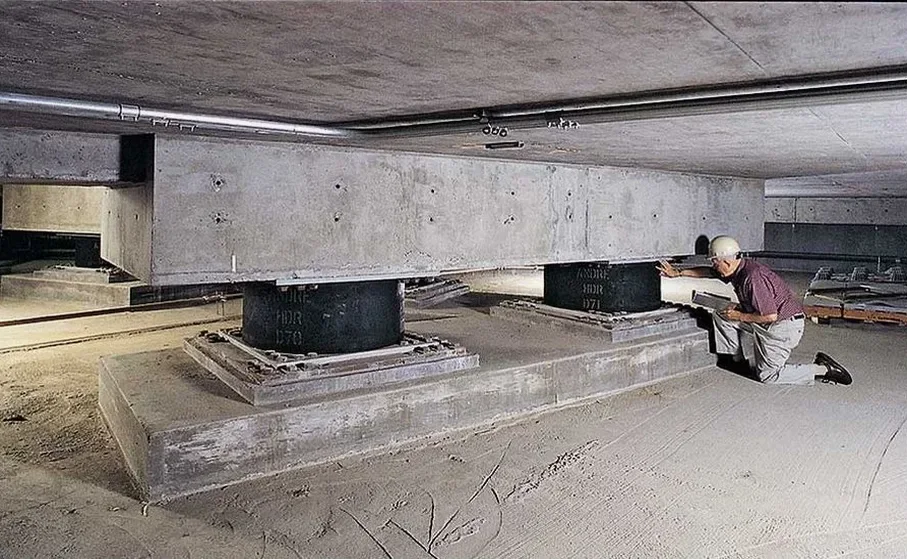
The contrast between the compact glacial till deposits underlying the Vieux-Saint-Jérôme district and the deeper silty clay pockets near Rivière du Nord creates distinct foundation responses under seismic loading. A seismic microzonation study often reveals that the same surface acceleration in downtown Saint-Jérôme produces different spectral demands at bedrock level versus the alluvial terraces west of Autoroute 15. This variability drives the need for base isolation seismic design that accounts for local stratigraphy rather than generic code spectra. We test isolator prototypes under bidirectional loading protocols that replicate the 2013 Ladysmith event and the Charlevoix seismic zone signatures, ensuring that the hysteresis loops and damping characteristics match the specific ground motion records relevant to Saint-Jérôme. The laboratory program includes full-scale bearing tests with simultaneous vertical load and horizontal cyclic displacement, following the procedures outlined in CSA A23.3 and the latest NBCC guidelines. For sites where soil amplification at long periods is a concern, we combine isolator testing with triaxial dynamic characterization of the subgrade to verify that the isolation frequency remains well below the soil's fundamental period.
Isolator performance at -30°C is not a code checkbox; it's the real condition your Saint-Jérôme building faces every January morning.
Process and scope
Site-specific factors
NBCC 2020 Article 4.1.8 requires that base-isolated structures in Saint-Jérôme be designed for the 2% in 50-year hazard level, which in the Laurentides region translates to a PGA of 0.25g to 0.35g on Site Class C. The risk amplifies when the isolator properties degrade beyond the bounds assumed in the upper- and lower-bound analyses. Scragging effects in lead-rubber bearings can reduce the effective yield force by 15% after the first cycle, and if the structural engineer does not account for this reduction, the superstructure drift may exceed the 1.0% limit under service-level earthquakes. We have observed that isolators stored on-site in Saint-Jérôme during winter without proper thermal protection exhibit a 20% increase in characteristic strength upon installation, which shifts the isolation period downward and brings the structure closer to the soil's predominant period. The consequence is a resonance condition that the original design did not anticipate. Our testing program includes scragging cycles and low-temperature conditioning to produce the property modification factors that close the gap between laboratory specifications and in-situ performance. The liquefaction assessment becomes equally critical where the Rivière du Nord alluvium contains saturated fine sands, because loss of bearing capacity under the isolator pedestals can induce rocking modes that bypass the isolation system entirely.
Reference standards
NBCC 2020 — National Building Code of Canada, Part 4, Division B, CSA A23.3-19 — Design of Concrete Structures, CSA S6:19 — Canadian Highway Bridge Design Code, ASTM D4014 — Standard Specification for Plain and Steel-Laminated Elastomeric Bearings for Bridges, ISO 22762 — Elastomeric seismic-protection isolators
Other technical services
Full-Scale Isolator Testing
Bidirectional cyclic loading of lead-rubber and high-damping rubber bearings up to 25,000 kN vertical capacity, with real-time hysteresis plotting and effective stiffness calculation per NBCC protocols.
Rubber Compound Characterization
Dynamic mechanical analysis (DMA) and strain-controlled shear testing of elastomer samples to determine G* and damping across temperature, frequency, and strain amplitude ranges relevant to Saint-Jérôme winter conditions.
Prototype Qualification Program
Complete test sequence including compression stiffness, shear stiffness, aging, ozone resistance, and low-temperature crystallization per CSA S6 and ISO 22762, with full documentation for peer review submission.
Typical parameters
FAQ
What does base isolation seismic design testing cost for a Saint-Jérôme project?
A complete isolator characterization program for a typical Saint-Jérôme building ranges from CA$5,350 to CA$9,860 depending on the number of isolator types, the required displacement amplitude, and whether low-temperature conditioning is specified. This includes the prototype qualification tests, property modification factor determination, and the final test report with hysteresis curves and effective damping ratios.
How does NBCC 2020 handle base isolation differently from previous editions?
NBCC 2020 introduces explicit requirements for upper- and lower-bound isolator properties in the analysis, and it mandates that the isolation system be tested at the maximum and minimum service temperatures expected at the building site. For Saint-Jérôme, this means the lower bound must reflect the stiffening that occurs at -30°C, while the upper bound accounts for heating effects during high-energy cyclic loading.
Can you test friction pendulum systems as well as elastomeric isolators?
Yes. Our test rig accommodates both curved-surface sliding isolators and flat sliding bearings with restoring elements. We measure the breakaway friction, the sliding friction coefficient as a function of velocity, and the wear effects over multiple cycles. For Saint-Jérôme projects where the near-fault pulse characteristics from the Charlevoix zone are a concern, we replicate the high-velocity pulses that can cause stick-slip behavior in sliding systems.
What documentation do you provide for the structural engineer and peer reviewer?
The test report includes the complete hysteresis loops for each loading protocol, the effective stiffness and equivalent viscous damping at each displacement amplitude, the backbone curve of shear modulus versus strain, the property modification factors for aging and temperature, and the statistical summary of all tested specimens. We also carry out the force-displacement data in digital format for direct input into nonlinear analysis software. All reports are signed and sealed by a professional engineer licensed in Quebec.