If you cross from the dense glacial till near the old cathedral sector over to the softer alluvial flats east of Boulevard Lachapelle, the ground tells a completely different story. One side offers competent bearing; the other, just a few hundred meters away, can barely support a slab without excessive settlement. Saint-Jerome’s post-glacial Champlain Sea deposits create these abrupt transitions, and that is precisely where stone column design becomes a practical alternative to deep foundations. We have seen projects where vibro-replacement columns were the only viable path to avoid removing three meters of compressible silt. The CPT test helps us map these soft lenses before defining the column grid, while the triaxial test on undisturbed samples gives us the undrained shear strength needed to run the cavity expansion model under NBCC requirements.
In Saint-Jerome’s Champlain Sea silts, a well-designed stone column grid can cut total settlement by half while keeping the project within a shallow foundation budget.
Process and scope
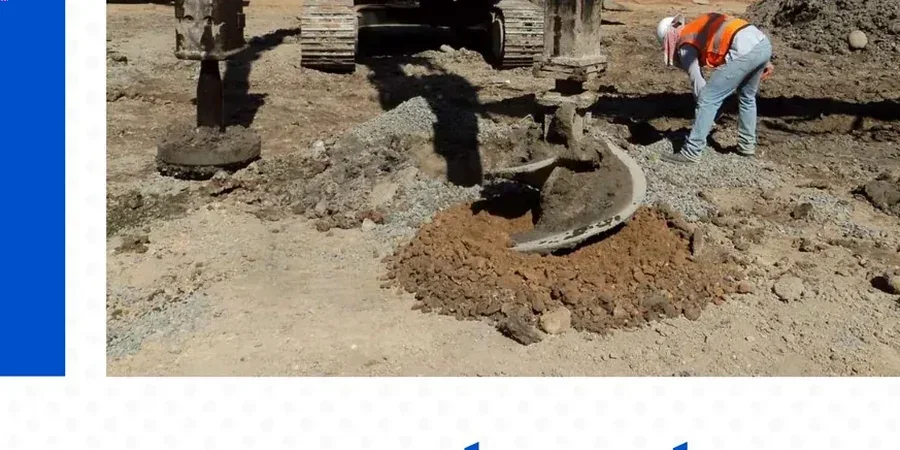
Site-specific factors
A three-storey mixed-use building on Rue Saint-Georges, right where the buried Rivière du Nord paleochannel crosses under the commercial strip, hit refusal on the first three vibroflot attempts. The soft organic silt layer, nearly five meters thick in that spot, was collapsing faster than the stone could backfill. We had to pause the installation, run a rapid in-situ permeability test to understand the drainage boundary, and adjust the stone column design to a staged installation with a larger diameter and reduced spacing. That episode underlines the real risk in Saint-Jerome: assuming uniform ground conditions across a site just because the surface looks flat. Incomplete site investigation leads to column lengths that fail to reach competent bearing, or spacing too wide to achieve the required composite modulus. The consequences are differential settlements that crack partition walls and jam doors within the first two winters. A design backed by sufficient CPT soundings and at least one full-scale trial column eliminates most of that uncertainty before the main contract starts.
Watch the video
Reference standards
NBCC 2020 – Division B, Part 4 (Structural Design) and geotechnical provisions, CSA A23.3-19 – Design of Concrete Structures (for pile caps interfacing with stone columns), ASTM D5778 – Standard Test Method for Electronic Friction Cone and Piezocone Penetration Testing of Soils, BNQ 2501-092 – Soils – Determination of grain size distribution
Other technical services
Pre-design Site Characterization
We run CPTu soundings and sample borings to map the thickness and consistency of the soft Champlain Sea deposits across the footprint. The undrained shear strength profile comes from field vane tests and triaxial compression on Shelby tube samples.
Stone Column Grid Design
Using the Priebe method and numerical cavity expansion models, we determine diameter, spacing, and length to achieve the target settlement reduction. Every design includes a liquefaction check where the NBCC seismic hazard index applies.
Trial Column and Load Testing
We supervise the installation of at least one trial column and conduct a plate load test on the composite ground. The measured load–settlement curve is compared directly to the design prediction, and the grid is adjusted if the modulus falls short.
Construction Monitoring and QA
During production, we log stone consumption per column, monitor amperage on the vibroflot, and perform periodic grain size checks on the backfill to ensure the crushed stone stays within the specified gradation band.
Typical parameters
FAQ
What does stone column design cost for a typical Saint-Jerome commercial lot?
For a standard commercial building footprint in Saint-Jerome, the complete design package—including CPT investigation, laboratory testing, column grid layout, and one trial column with plate load test—ranges from CA$2,120 to CA$7,210 depending on the number of columns and the complexity of the soil profile.
How deep do stone columns need to go in the Saint-Jerome area?
In our expertise east of Autoroute 15, columns typically extend 4 to 12 meters to reach the underlying glacial till or a competent bearing layer. The exact depth is determined by CPT refusal and the undrained shear strength profile; we never terminate a column in a zone still reading below 20 kPa unless the composite modulus check explicitly allows it.
Can stone columns replace piles entirely under a five-storey building?
It depends on the sensitivity of the clay and the total load. For lightly sensitive Champlain Sea silts with undrained strengths above 20 kPa, a dense stone column grid can often bring settlements within acceptable limits for a five-storey concrete frame. If the clay is highly sensitive or the seismic drift requirements are very tight, we sometimes combine stone columns with a rigid inclusion or a structural raft.