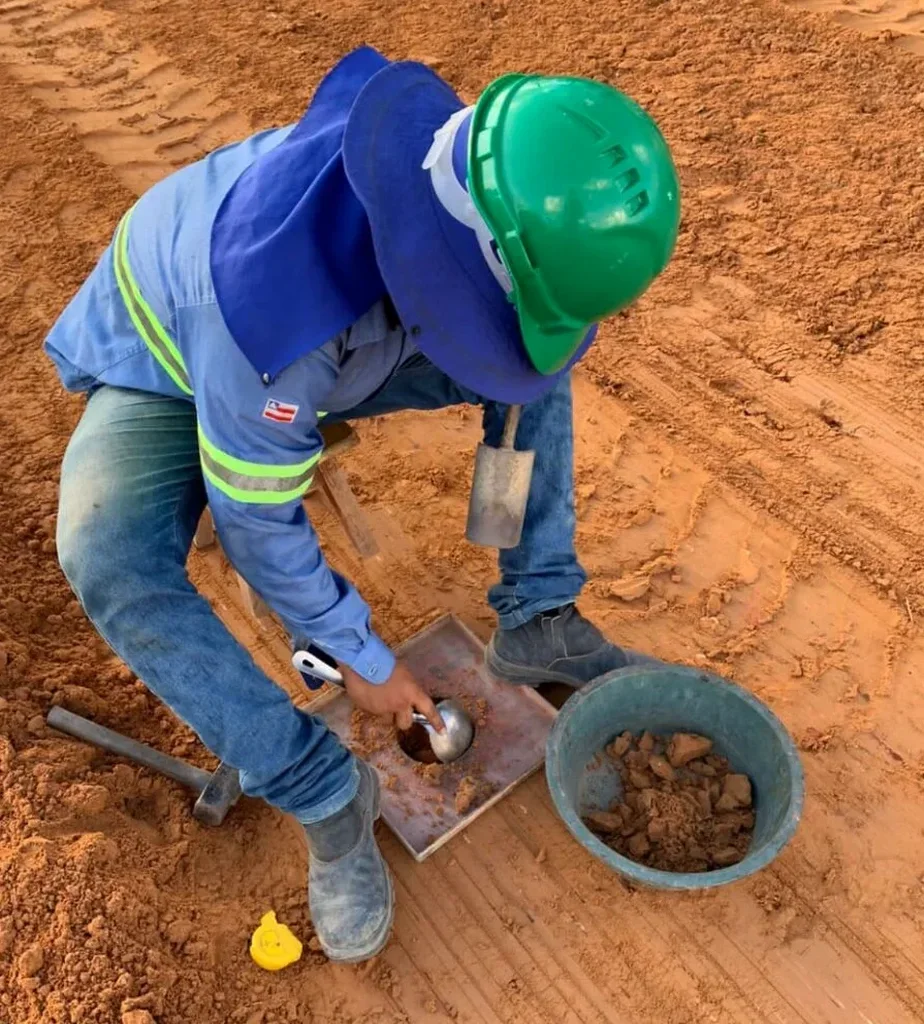
Saint-Jerome sits on the edge of the Laurentian foothills, where the Rivière du Nord cuts through layers of glacial till and sandy outwash deposits. The freeze-thaw cycles here are aggressive. A wet spring can saturate the subgrade along Rue Labelle, and if the compaction isn't verified with a sand cone density test, you're gambling with differential settlement before the asphalt even cures. We see it every season: contractors who skip field density testing end up chasing cracks two winters later. The sand cone method gives you a direct measurement of in-place density that no nuclear gauge can match in these heterogeneous glacial soils. It's the reference standard for a reason, and when you're backfilling around a frost wall in Saint-Jerome's clayey silts, you want a number you can trust. Combined with a grain size analysis to understand the fines content, the compaction picture becomes clear.
In Saint-Jerome's glacial soils, a nuclear gauge can misread moisture by 4%. The sand cone method doesn't lie.
Process and scope
Site-specific factors
Saint-Jerome's population has grown steadily past 75,000, pushing new residential subdivisions onto former agricultural land and forested slopes east of Highway 15. These areas often have a thin crust of stiff clay over soft, compressible silts. The risk isn't theoretical. A poorly compacted driveway approach or a utility trench backfill in these conditions settles within two winters, cracking sidewalks and pulling away from foundations. We've measured density deficiencies as low as 82% Proctor in trench backfill along municipal sewer lines on Rue Brière. The repair cost dwarfs the testing budget. When the frost penetrates 1.2 metres into uncompacted fill, the heave is uneven and destructive. For retaining wall backfill in sloped developments, we often recommend pairing density testing with a slope stability assessment to ensure the compacted zone contributes to overall stability.
Reference standards
ASTM D1556 - Standard Test Method for Density and Unit Weight of Soil in Place by Sand-Cone Method, CSA A23.2-11A - Field Density Test by the Sand Cone Method, ASTM D698 / D1557 - Standard Proctor / Modified Proctor Compaction (lab reference), NBCC 2015 - National Building Code of Canada (compaction requirements), BNQ 2560-114 - Granular Materials (Quebec specification for backfill materials)
Other technical services
Laboratory Proctor Compaction
We run Standard or Modified Proctor tests (ASTM D698/D1557) on your fill material to establish the reference maximum dry density and optimum moisture content before any field testing begins.
Nuclear Gauge Density (with sand cone calibration)
For larger sites needing rapid coverage, we use nuclear gauges calibrated against sand cone results on the same material, giving speed without sacrificing accuracy.
Trench Backfill Compaction Verification
Focused testing on utility trenches and foundation backfill, where narrow excavations make compaction difficult and settlement risk is highest for adjacent pavements and structures.
Typical parameters
FAQ
How much does a sand cone density test cost in Saint-Jerome?
For sites in Saint-Jerome and the surrounding Laurentides area, a single sand cone test typically ranges from CA$140 to CA$220 per point, depending on the number of points per visit and mobilization distance. A half-day with five to six tests usually falls in the CA$800-CA$1,200 range. We always carry out a fixed quote before mobilizing.
Why use the sand cone instead of a nuclear gauge?
The sand cone is a direct measurement: you excavate a known volume of soil, weigh it, and calculate density. There is no calibration curve affected by soil chemistry or moisture anomalies. In Saint-Jerome's glacial tills, which often contain trace organics and variable mineralogy, the sand cone remains the referee method. It is also the only method accepted by many municipal inspectors for final lift acceptance on public works.
How many tests do I need for my site?
It depends on the project specification, but a common rule is one test per 300 square metres per compacted lift, or one test per 30 linear metres of utility trench. For a typical single-family home lot in Saint-Jerome, we recommend a minimum of four to six points covering the building pad, driveway, and any significant utility backfill. We can help you develop a testing plan that satisfies your geotechnical engineer's requirements.