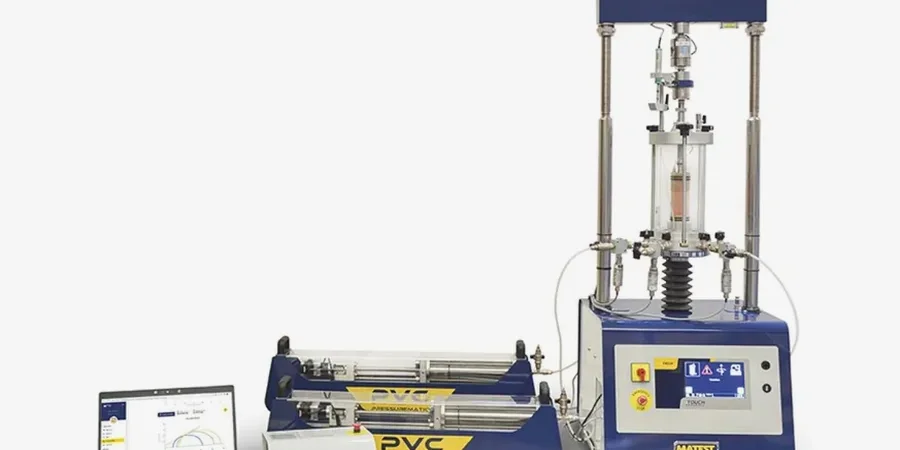
In Saint-Jerome, we repeatedly see foundation reports that rely on generic bearing capacity tables without accounting for the complex stress paths that the Rivière du Nord's ancient terraces impose on the soil. The compact glacial till and sensitive silts found across the lower Laurentians demand a precise determination of the Mohr-Coulomb envelope, something we obtain directly in our triaxial frame. We run consolidated-undrained tests with pore pressure measurement to isolate the effective stress parameters c' and φ', data that becomes critical when designing retaining structures or slope cuts near the old paper mill district. For projects on the sandy lenses east of Autoroute 15, engineers often combine our triaxial data with an SPT drilling campaign to correlate in-situ blow counts with the laboratory-derived friction angle, establishing a reliable ground model before the excavation phase begins.
The effective friction angle φ' from a CU triaxial test in the Saint-Jerome till typically falls between 32° and 36°, a range that directly governs the lateral earth pressure coefficient used in basement wall design.
Process and scope
Site-specific factors
The neighborhoods built on the thick clay deposits near the Rivière du Nord floodplain behave completely differently from the till-covered slopes of Bellefeuille when subjected to shear. In the central, low-lying sectors of Saint-Jerome, the soft clay can develop positive excess pore pressure during rapid loading, reducing the available undrained shear strength to values that put shallow footings at risk of bearing failure. We have measured Su/σ'v ratios below 0.20 in samples extracted near the old railway corridor, a number that forces the geotechnical designer to consider deep foundations instead of spread footings. On the higher terraces to the north, the overconsolidated till exhibits a dilatant response, and the triaxial test captures the peak strength and the subsequent drop to the critical state, essential information for evaluating the progressive failure mechanism in long-term excavations. Ignoring these spatial variations in Saint-Jerome, and applying a single friction angle across the entire lot, is the most direct path to unexpected movements during the construction phase.
Reference standards
ASTM D4767 (CU with pore pressure measurement), ASTM D7181 (CD test method for granular soils), CSA A23.3 (concrete structures, reference for soil-structure interaction), NBCC 2015 (seismic and serviceability design requirements)
Other technical services
CU Triaxial with Pore Pressure
Consolidated-undrained test for cohesive and mixed soils. We measure the generated pore pressure to separate total and effective stress paths, delivering c' and φ' for effective stress analysis.
CD Triaxial (Drained)
Drained test for granular soils and long-term stability scenarios. We control the shearing rate to maintain zero excess pore pressure and obtain the drained friction angle φd.
UU Triaxial (Quick Undrained)
Unconsolidated-undrained test for rapid loading conditions on low-permeability soils. Provides the undrained shear strength Su and total stress parameters for end-of-construction checks.
Multi-stage Triaxial
A single specimen is tested at increasing confining pressures, ideal for Saint-Jerome projects with limited undisturbed sample recovery. We report the Mohr-Coulomb envelope from 3 or 4 successive shear stages.
Typical parameters
FAQ
How many specimens do you need to define c' and φ' for a Saint-Jerome project?
We typically require three undisturbed specimens from the same stratum, consolidated to different effective confining pressures that bracket the in-situ stress. This gives us three Mohr circles and a well-defined failure envelope. If the layer thickness exceeds 2 metres or the material varies noticeably, we recommend at least one additional specimen to capture the variability of the Laurentian till.
What is the cost range for a CU triaxial test program in Saint-Jerome?
A complete program with three CU triaxial tests, including specimen preparation, saturation, consolidation, shear, and a report with c' and φ' values and stress-strain curves, ranges between CA$2,720 and CA$3,370. The final cost depends on the specimen diameter and the consolidation time required to reach full pore pressure dissipation in the low-permeability silts.
How do you select the shearing rate for a CU test on Saint-Jerome clay?
We calculate the shearing rate from the coefficient of consolidation obtained during the consolidation stage, following the ASTM D4767 criterion that requires the time to failure to be at least 10 times the time to 50% consolidation. For the sensitive clay near the Rivière du Nord, this often results in a rate between 0.01 and 0.03 mm/min, a slow shear that ensures pore pressure equalization across the specimen and a reliable effective stress path.