Saint-Jérôme’s development along the Rivière du Nord shaped its urban fabric atop a complex sequence of marine and glacial deposits. The city sits roughly 45 kilometers northwest of Montreal at an elevation near 100 meters, where the retreat of the Champlain Sea left behind thick layers of sensitive silty clay interspersed with till. A shallow foundation design here must account for this legacy: the surficial crust often masks softer, compressible material at depth. Our laboratory runs consolidation and strength tests on Shelby tube samples extracted from these horizons, feeding parameters directly into bearing capacity models. Before finalizing footing geometry, we often recommend test pits to verify the stratigraphy at column locations, and CPT testing where continuous profiling through the sensitive clay zone is needed without disturbing the soil structure.
On Saint-Jérôme’s Champlain Sea clays, footing settlement usually controls the design long before the bearing capacity limit is reached.
Process and scope
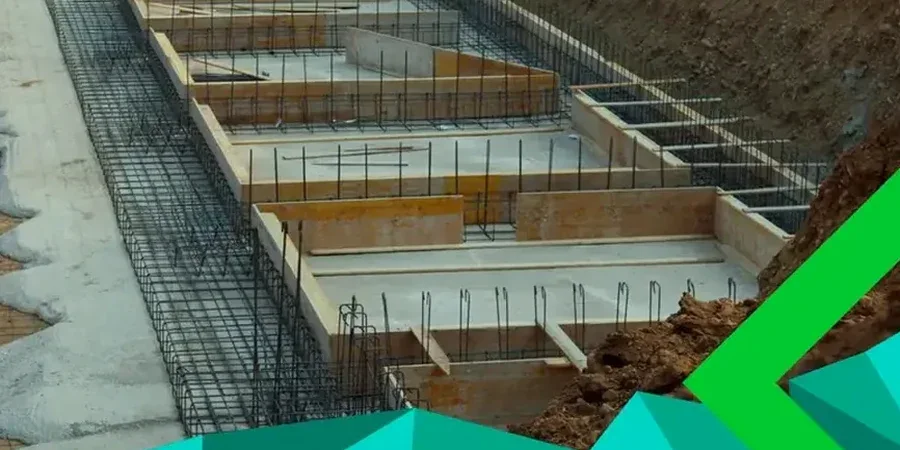
Site-specific factors
The Champlain Sea clay underlying much of Saint-Jérôme is prone to sensitivity and can lose significant strength when remolded. A shallow foundation design that ignores the potential for progressive failure or long-term creep settlement in these deposits risks differential movement between columns. The water table often sits within 2 meters of the surface along the Rivière du Nord corridor, complicating excavation and requiring careful dewatering during footing construction. Our consolidation curves from oedometer tests pinpoint the preconsolidation pressure, distinguishing normally consolidated zones from lightly overconsolidated crust. Where the clay thickness exceeds 3 meters, we calculate settlement under the serviceability limit state using Skempton-Bjerrum corrections, ensuring the total and differential movements stay within the CSA A23.3 tolerances for the superstructure type.
Watch the video
Reference standards
NBCC 2020 (National Building Code of Canada), CSA A23.3-19 (Design of Concrete Structures), Canadian Foundation Engineering Manual, 4th Edition
Other technical services
Bearing Capacity and Settlement Analysis
Calculation of factored and service-level bearing resistance using limit states design per the Canadian Foundation Engineering Manual. Includes immediate and consolidation settlement estimates for footings and mat foundations on the Champlain Sea deposits.
Footing and Mat Foundation Design
Dimensioning and reinforcement specification for spread footings and slab-on-grade systems per CSA A23.3. We incorporate frost protection depth requirements and seismic tie-beam detailing for Saint-Jérôme's site class conditions.
Typical parameters
FAQ
What does a shallow foundation design for a Saint-Jérôme residential project cost?
For a typical single-family home on a standard lot in Saint-Jérôme, the geotechnical investigation and shallow foundation design report ranges from CA$2,850 to CA$4,410. The final cost depends on the number of test pits or boreholes required to characterize the clay thickness and the complexity of the structural loads.
How deep do footings need to be in Saint-Jérôme to avoid frost heave?
The NBCC specifies a frost penetration depth of at least 1.2 meters for the Saint-Jérôme region. We design footing embedment to this minimum, though the presence of frost-susceptible silty clay often necessitates extending to 1.5 meters or placing a granular pad beneath the footing.
Can you design a shallow foundation on the sensitive clays near the Rivière du Nord?
Yes, but it requires careful evaluation of the clay sensitivity and preconsolidation pressure. We use undisturbed sampling and oedometer testing to ensure the applied stress from the footing remains below the preconsolidation pressure, avoiding large consolidation settlements. In some cases, a mat foundation distributes the load more effectively than isolated footings.
What laboratory tests are critical for shallow foundation design here?
Consolidation tests (oedometer) for settlement prediction, unconfined compression and triaxial tests for undrained shear strength, and Atterberg limits to classify the clay plasticity are essential. We also run grain size analysis on the glacial till to confirm its drainage characteristics beneath the footing.