Saint-Jerome's growth from a pulp-and-paper hub to a residential gateway for the Laurentians has pushed construction onto terrain that demands serious retaining wall design. The city sits in the Rivière du Nord valley, with dense marine clay deposits left by the Champlain Sea. In our expertise, a 1.5-meter cut here behaves like a 3-meter cut in sand. The clay is sensitive and loses strength when remolded. We combine local borehole data with CPT testing to map the transition between the stiff upper crust and the softer clay below. For hillside lots near Bellefeuille, we often specify the wall after a slope stability analysis confirms the global safety factor against deep-seated failure.
In Saint-Jerome clay, a retaining wall without a working drainage system is a future failure with a frost date stamped on it.
Process and scope
Site-specific factors
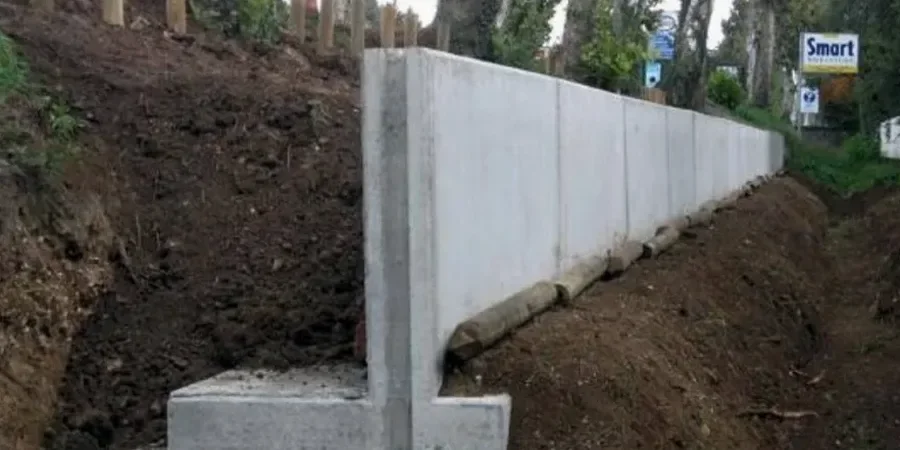
What we see too often in Saint-Jerome: a contractor pours a gravity wall in late October, backfills with silty site soil, and walks away. By February the ground has heaved, the wall has tilted, and the owner is calling us in a panic. The Champlain clay here has a drained friction angle below 28 degrees, and when frozen, the backfill expands laterally. That combination cracks stems and shears keys. We check the global stability with Bishop's method when the wall sits mid-slope, and we never approve a design without a continuous weeping tile at the base. For taller walls over 3 meters, we move to a mechanically stabilized earth design using geogrid reinforcement with select granular backfill.
Reference standards
NBCC 2015: Division B, Part 4 (Structural Design) and Part 9 (Housing and Small Buildings), CSA A23.3-14: Design of Concrete Structures, ASTM D4767: Standard Test Method for Consolidated Undrained Triaxial Compression Test for Cohesive Soils
Other technical services
Geotechnical investigation for retaining walls
One to three boreholes at the wall alignment, Shelby tube sampling in the Champlain clay, laboratory triaxial testing, and a factual report with design soil parameters. We log the depth to till or bedrock—critical because bearing on the glacial till at 5 to 8 meters solves most settlement problems.
Structural design and construction review
We produce stamped design drawings for cantilever, gravity, and MSE wall types. Includes reinforcement schedules per CSA A23.3, drainage details, and review of the contractor's formwork and backfill compaction during construction.
Typical parameters
FAQ
What does a retaining wall design cost in Saint-Jerome?
The engineering fee for a typical residential or light commercial retaining wall in Saint-Jerome ranges from CA$1,380 for a simple cantilever design with existing soil data, up to CA$6,120 for a full investigation, triaxial testing, and stamped drawings for a wall over 2.5 meters or near a property line.
How deep must the footing be for a retaining wall in the Laurentians?
We set the bottom of the footing at minimum 1.4 meters below exterior grade to get under the frost line per NBCC climatic data for Saint-Jerome. In Champlain clay, we sometimes go deeper to find a stiffer consistency or to bear on the glacial till if it is within reach.
Can you design a wall on a steep slope near the Rivière du Nord?
Yes. Slope stability becomes the controlling factor on lots that pitch toward the river. We run a limit equilibrium analysis with effective stress parameters from the triaxial tests and often specify an MSE wall with geogrid reinforcement to reduce the excavation footprint and maintain global stability.